See it
The readiness console, on your own machine.
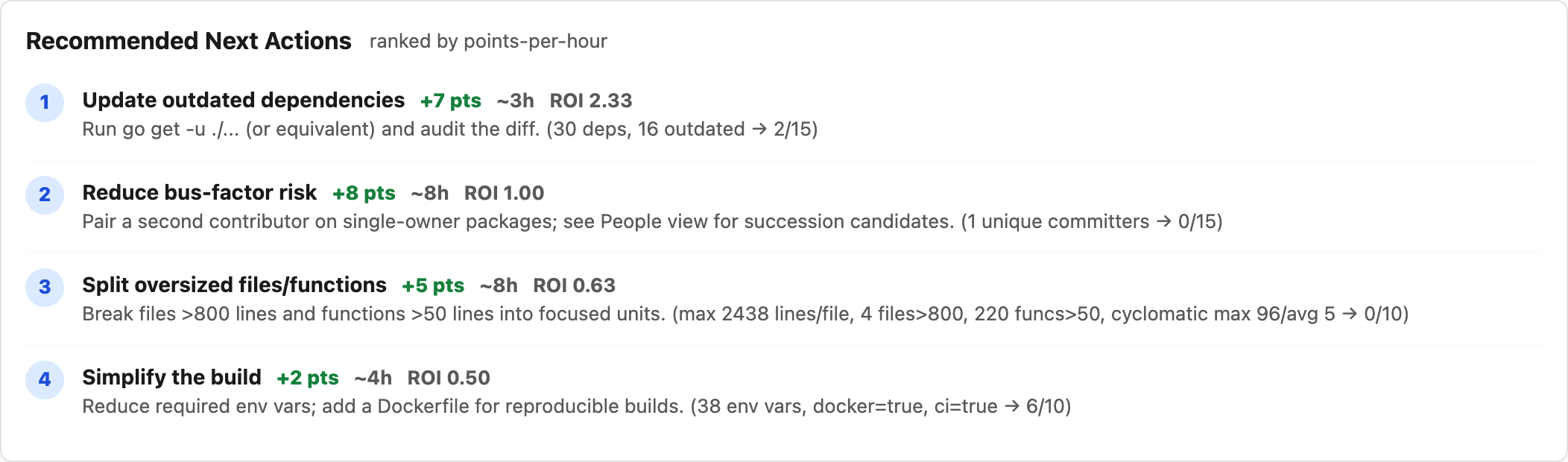
One score, and a ranked punch list of what to fix next, ordered by points-per-hour so the cheapest wins come first. No dashboards to host, no code leaves your laptop.
A senior engineer asks a dozen questions before touching your code:
Your AI coding assistant has no idea which files are load-bearing, what changed last week, or who owns what. ReadyBase studies your codebase once and hands your AI the smallest, most relevant map for every turn, so it works like a senior engineer who grew up here, not a stranger guessing. And it watches for vibe drift: AI output that passes review but doesn't fit how your team actually builds.
readybase relate before editing.ReadyBase is two planes, one mission: Prefex rows cheaper, ReadyBase steers smarter.
A clear 0-100 grade for how safely AI can work in your codebase, weighted by risk — not size — so a big, well-owned repo isn't punished and a fragile one can't hide. Every gap comes with the exact fix that raises it.
Pinpoint the riskiest files so cleanup starts where it matters most.
Ask structural questions: what depends on this file, what changed here, where should I start?
Warns before a risky change, stops AI from breaking things it didn't know it touched.
Learns your repo's conventions and flags vibe drift — AI output that compiles and passes review but doesn't match how your team actually builds.
A one-page, manager-facing verdict: is this repo AI-safe yet, and what's left to fix?
Rank every repo by readiness and watch the numbers improve over time.
Plugs into your AI assistant invisibly, context and warnings arrive at the right moment.
A browser view for scores, gaps, and codebase health, no terminal needed.
Four levels, L0 to L3, that say how far an agent may run on this repo. Each level is gated on evidence, not opinion: unresolved structural drift, gaps in the protected-file list, or missing cost telemetry hold a repo back until they are fixed.
Opt a repo into agent mode and the guard stops refusing politely. An edit to a protected file is rejected before it happens. A human clears one file at a time, with an approval that expires on its own.
Traces which request handlers can actually reach a process-execution or outbound-network call, and whether user input reaches it unsanitised along the way. Call-graph precision, no JVM, no sidecar.
How much of each file was written by an agent, and whether one human has ever reviewed it. The answer to "who owns it when the AI breaks something", derived from git rather than asserted.
The same three layers that sit under Prefex, pointed at a different plane. Prefex measures, auto-applies, and coaches your spend. ReadyBase does the same for your code's safety.
One scan builds the dependency graph, co-change history, ownership, and complexity map of your repo. You can't guard what you haven't mapped.
Rules and context inject themselves into the AI session. No prompt engineering, no workflow change. For a human it stays advisory; for an agent it can refuse the edit outright. The danger zones defend themselves.
Blast-radius warnings in the moment, a readiness score over time, a one-page certificate for leadership, and an autonomy ladder that says how far an agent may run unattended. A risk you see before you commit changes what you commit.
A ReadyBase error never blocks your work. On bad input or a slow path, it logs and gets out of the way. The guard is never a single point of failure.
One CGO-free Go binary. No runtime, no sidecar to supervise, no service phoning home. It reads your repo on disk and writes plain files you can diff.
Everything runs on localhost, against your own git history. No telemetry, no upload, no third party in the loop. See the privacy details →
We study the sharpest ideas in code intelligence, extract the intuition, and re-author it local-first inside our own principles.
ReadyBase attaches the smallest, most relevant context to every AI turn — keeping sessions grounded in your actual codebase, not hallucinated assumptions — while quietly watching for vibe drift: AI output that works, but doesn't fit how your team actually builds.
Not the whole codebase dumped into the prompt. For each turn, the smallest slice that matters — the dependents, the owners, the recent churn around what's being touched — so the model stays grounded and you don't pay for noise.
From the AST and git history, ReadyBase infers how you build — naming, structure, error handling, test shape — by consensus, not a style guide nobody reads. That baseline is what drift is measured against.
Code that compiles and passes review can still be subtly off-house-style. Coherence surfaces it as it happens — not three months and a thousand copy-paste lines later, when it's the new normal.
Two axes, one binary: readiness tells you if AI can work here safely, coherence tells you whether what it wrote belongs.
One score, and a ranked punch list of what to fix next, ordered by points-per-hour so the cheapest wins come first. No dashboards to host, no code leaves your laptop.
ReadyBase comes inside the PromptForce app, alongside Prefex.
ReadyBase Pro activates on first run for 45 days, with no key to paste and no network call. It stops when Prefex's licence on the same machine stops. After that, renew with a free 30-day key.
Shared scores and guardrails across a portfolio of repos, on request. See the team guide or talk to us.
One download installs ReadyBase beside Prefex and connects Claude Code and Codex. Your code never leaves your machine.